
Doritos All Dressed NPCs
The Fortnite campaign that turned the most ignored thing in gaming into the most talked about.
In-game brand activations are not new. Balenciaga launched a digital fashion line in Fortnite. Wendy’s live-streamed nine hours of destroying freezers in Fortnite restaurants to protest frozen beef. Nike built an entire world inside Roblox. The pattern is familiar: brand enters game, brand sponsors character skins or builds a branded map, brand gets some press.
What Doritos did in the summer of 2023 was different. Not because it was technologically complex or because they spent more money. It was different because they noticed something everyone else had ignored.
The invisible characters
Every game has non-playable characters. NPCs. They’re the background filler, the shopkeepers and bystanders who exist to make the game world feel populated. Nobody pays attention to them. They’re so unremarkable that “NPC” has become internet slang for a person who moves through life without independent thought.
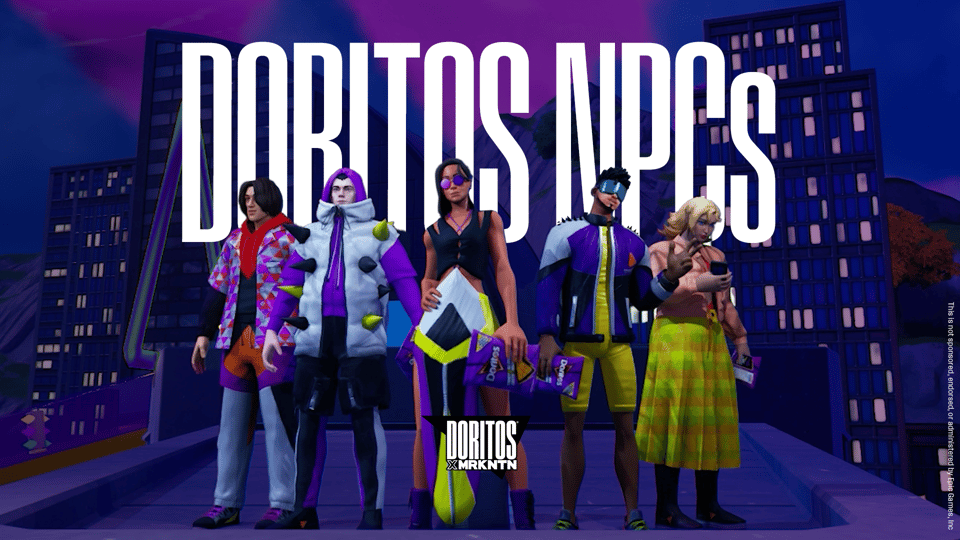
Doritos, working with BBDO Canada, decided to make NPCs the centerpiece of a campaign. Instead of sponsoring the outfits that players wear, which is the standard playbook, they created a high-fashion collection exclusively for the characters nobody looks at.
The logic was counterintuitive but sound. Everyone sponsors main character skins. That space is crowded and expensive. NPCs are a blank canvas that nobody has touched. By dressing the characters players are trained to ignore, Doritos created something genuinely surprising in a category where surprise is increasingly rare.
Lisa Allie, senior marketing director at PepsiCo Foods Canada, told Campaign Canada: “The most unexpected thing we could do to support our limited-edition flavour this summer was to make the clothing drop limited for NPCs. This was our opportunity to pull them out of the background and help them boldly stand out.”
What they built
The campaign launched a limited-time Doritos flavor in Canada: Tangy All Dressed. To promote it, BBDO Canada partnered with Montreal skate-couture designer Markantoine Lynch-Boisvert (known as MRKNTN) to create five bold, Doritos-branded outfits. These weren’t slapped together. They were designed as a legitimate fashion collection, with the bold colors and triangular shapes of the Doritos brand translated into streetwear.
The outfits were placed on custom NPC models inside “Doritos Drip City,” a fully playable Fortnite map built by Pixel Hunters. Each NPC held a bag of Doritos Tangy All Dressed and had a challenge associated with it that players could unlock by interacting with the character. The map launched July 5, 2023 and ran through the end of August.
The reveal happened through a two-hour Twitch live stream hosted by Canadian Fortnite creator Nick Eh 30, who has 5.8 million followers. The choice of creator mattered. Nick Eh 30 has genuine authority in the Fortnite community. He wasn’t just reading a brand script. He was exploring the map live, reacting to the NPC outfits in real time, and his audience was reacting with him.
The campaign extended across TikTok, Instagram, YouTube, and a custom 3D billboard at Toronto’s Yonge Dundas Square. A dedicated microsite at DoritosNPCs.ca let fans explore the collection outside the game.
The unplanned second act
Here’s where it gets interesting. During the Twitch stream, someone in the chat said they were sad they couldn’t add the NPC outfits to their actual wardrobe. Doritos already had the designs. So they took that feedback and turned the digital fashion line into real, physical clothing.
This wasn’t part of the original plan. It was a response to a signal from the audience, executed quickly because the creative assets already existed. The pivot gave the campaign a second wave of attention and earned media that extended well beyond the gaming community.
It also demonstrated something important about the relationship between digital and physical products. The virtual collection functioned as a proof of concept. Doritos could test demand for the designs risk-free inside a game, then produce physical versions only after they’d confirmed people actually wanted them. That’s a product development loop that fashion brands are only beginning to figure out.
The numbers
The Shopper Innovation Awards case study and One Club submission lay out the results clearly.
Sales of the Tangy All Dressed flavor jumped 36%. Brand awareness hit 70% among the target demographic. The Twitch live stream smashed benchmarks across the board: chat engagement was up 325.9%, viewership exceeded benchmarks by 279%, and total minutes watched surpassed benchmarks by 619.8%, per the 2023 Media Agency Campaign Tracking Report.
Inside the game, players averaged 30 minutes of playtime on the Doritos Drip City map, which is five times higher than the average for branded Fortnite experiences. PR coverage garnered 18.8 million impressions across 178 outlets, more than double the brand’s internal goal of 7.4 to 10.3 million.
The campaign won at the Strategy Awards and Shopper Innovation Awards in 2024. BBDO Canada’s submission noted that the campaign “uncovered a new placement opportunity in gaming and made the first fashion drop the brand’s target couldn’t wear into something they couldn’t miss.”
Why this matters beyond Doritos
Brand activations inside Fortnite nearly doubled between 2023 and 2024, rising from 136 to 270, according to GEEIQ’s 2025 State of Brands in Gaming report. Branded Fortnite maps now account for 33% of all virtual-world brand activations. Companies typically spend between $300,000 and $500,000 on a custom map.
But there’s a growing problem: many of these activations don’t perform. Digiday reported that Fortnite creators are increasingly vocal about brands wasting money on custom maps that draw tiny player counts. The debate mirrors what happened on Roblox, where brands learned that simply existing inside a game isn’t enough. You have to give players a reason to care.
Doritos found that reason by inverting expectations. The $50 billion character customization industry is built around players dressing their own avatars. Doritos said: what if we dress the characters nobody dresses? The inversion is what made it noteworthy, shareable, and genuinely fun to engage with.
The in-game advertising market is projected to reach somewhere between $124 billion and $156 billion by the early 2030s depending on which research firm you ask (Statista, IMARC). Sixty-two percent of Gen Z gamers say they discover brands through video games, making gaming more influential than television for this demographic, according to research cited by Amra and Elma. And Bain & Company’s Gaming Report 2025 found that 46% of gamers often make purchases based on in-game ads, up from 40% the year before.
The opportunity is enormous and growing. But as more brands pile into game worlds with generic activations, the ones that will stand out are the ones that find the creative equivalent of what Doritos found: the thing everyone overlooks, the NPC of marketing tactics, that turns out to be the most interesting thing in the room.
What to take from this
Three things worth carrying forward.
First, look for the thing nobody is doing, not a better version of what everyone is doing. Every brand was sponsoring player skins. Doritos sponsored NPCs. The creative gap between “slightly better execution of the standard approach” and “genuinely novel angle on a familiar tactic” is where the outsized results live.
Second, choose creators who authenticate, not just amplify. Nick Eh 30 wasn’t a generic influencer reading talking points. He was a Fortnite native with real credibility in the community. His two-hour live stream wasn’t a commercial. It was content his audience would have watched regardless, which happened to feature a brand activation worth reacting to. The difference between a creator who authenticates your idea and one who merely distributes it is the difference between 30-minute average playtime and the forgettable branded map that nobody visits twice.
Third, build campaigns that can respond to their audience. The physical clothing line wasn’t planned. It happened because someone in a Twitch chat expressed a desire, and the team was set up to act on it. Having the flexibility to extend a campaign based on real-time audience signals is increasingly what separates good activations from great ones. Plan the first move. Leave room for the second one to emerge from the response.