
Rovio Made 51 Games That Flopped.
Here's What Actually Happened With the 52nd.
Hey, happy Tuesday.
Quick one before we get into it.
If someone forwarded this to you—first, they have good taste. Second, you can subscribe here. Takes like four seconds.
Okay. Today’s issue:
Rovio made 51 games that nobody cared about. Then they made Angry Birds with €25,000 and twelve people left in the building. Three billion downloads later, here’s what actually happened.
2009. Helsinki. Twelve people left.
That’s where this story starts. Not with a brilliant eureka moment, not with VC money or a Stanford dorm room. It starts with a Finnish studio that was basically cooked.
Rovio Entertainment, or Rovio Mobile as it was called then, had been grinding since 2003. Three students from the Helsinki University of Technology, Niklas Hed, Jarno Väkeväinen, and Kim Dikert, won a Nokia and HP-sponsored mobile game competition and figured hey, let’s start a company. Made sense at the time. They were good at building games. Distribution though? That was another thing entirely.
For six years they shipped games. Sci-fi stuff, horror stuff, titles that were probably decent but went nowhere because nobody could find them. They made 51 games. Fifty-one. And by 2009 the money was basically gone. They’d had to let most of the team go. Twelve people left in the building. Maybe eight by some accounts. However you count it, tiny.
The board brought in Mikael Hed, Niklas’s cousin, as CEO. New blood, same problem: they had enough budget for maybe one more swing. One game. €25,000. That’s like $27,000 in today’s terms, which is not a lot of money to build anything, let alone a game that would eventually be downloaded three billion times.
Before we begin... a big thank you to this week’s sponsor.

Marketing that’s always on—even when you’re not. Get automation tools that send your messages for you.
You can’t be everywhere at once—but your marketing can.
With Constant Contact’s automation tools, your emails, texts, and offers go out at the right time, every time—without you having to lift a finger.
Want to show your audience you care about them? Use an automaton template to send birthday messages. Working on driving sales? Set up an abandoned cart email automation to gently urge almost-shoppers to become actual shoppers. Looking to bring lapsed customers back into the fold? Send automations with offers and promos to entice them to buy again. You can even create custom automation paths that work best for your business.
It couldn’t be easier. Just set up automatic triggered messages based on your customers’ behavior, and watch those messages run while you focus on everything else.
SECOND ORDER readers, if you’re ready to save time and put pesky administrative tasks on autopilot, give Constant Contact’s marketing automation tools a try. Get started today—for free.
The Sketch That Changed Everything
The iPhone had come out in 2007 and the Rovio team, to their credit, were paying attention. They spent time thinking about what kind of person uses an iPhone. Their answer was basically: everyone. That sounds obvious now, but it was actually a pivot from how they’d been thinking. Their previous games were niche, made for specific audiences. This time they wanted something universal.
So they put Jaakko Iisalo, their senior game designer, on concepts. He pitched a bunch of ideas, nothing was clicking. Then at some point in early 2009, he shows up with a screenshot. Just a static image. Round, angry-looking birds. No legs. No wings visible. Just these little furious creatures staring out of the screen.
Mikael Hed’s description of what happened next: “People saw this picture and it was just magical.” Which is kind of funny because on paper, angry legless birds are not a business plan. But there was something there. The characters had personality before the game even existed.
They built a game around the image. Physics games were popular at the time, specifically something called Crush the Castle, and they basically took that mechanic, birds launching from a slingshot to knock structures down, and wrapped it around these characters. The pigs became the villains because swine flu was everywhere in the news in 2009, which is maybe the most random product decision in startup history, but it worked.
They built the thing in about six months. The whole time, they were also doing contract work for other companies to keep the lights on. So the game that would eventually save the company was made on the side while they were building other people’s games.
The “we knew we had something” moment: every time a developer shot a bird to test a feature, five other people in the office would end up watching. And then Niklas’s mother, who doesn’t play games, played a pre-release build and burned her Christmas turkey because she got too into it. If your non-gamer parent can’t put your game down, you’re onto something.
Angry Birds launched on iOS in December 2009.
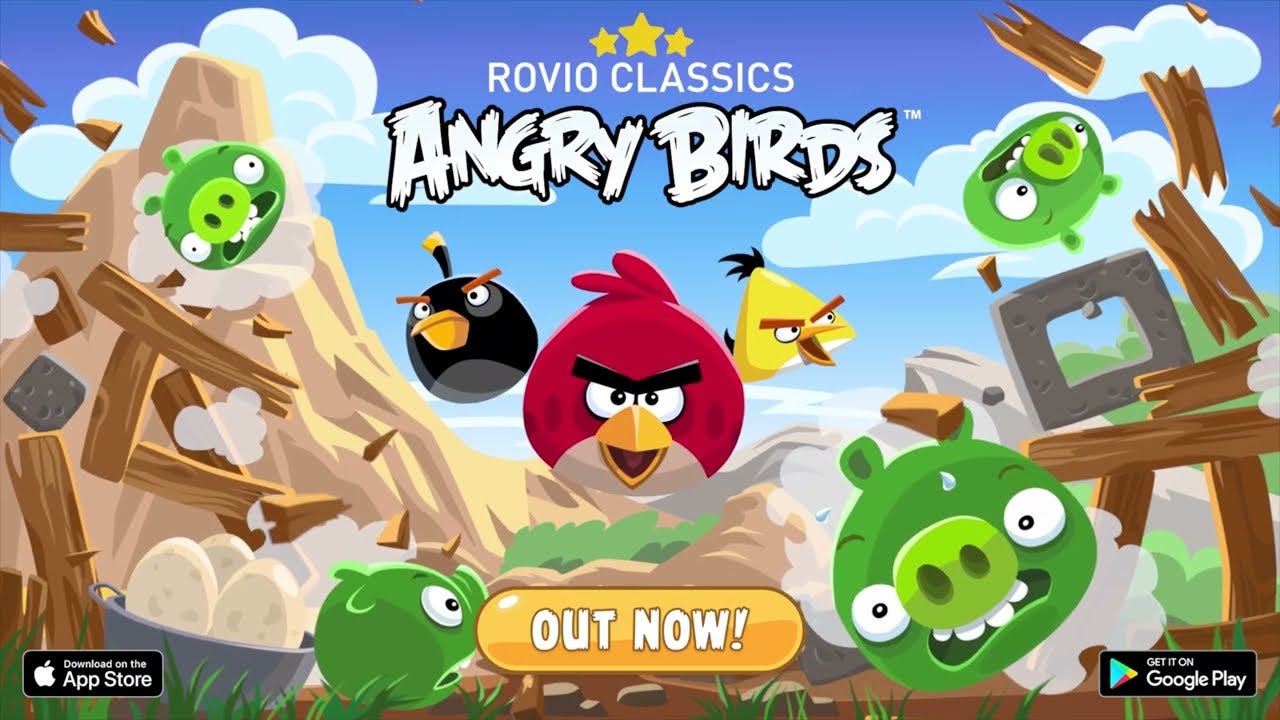
It went nowhere.
The Distribution Play
The US and UK markets basically ignored it. And here’s where the story gets actually interesting, because what Rovio did next is the part that gets left out of the usual “persistence pays off” version of this story.
Instead of trying to force their way into the big markets, they went small. Finland first. A few hundred downloads and they hit the top of the Finnish charts. Then Sweden. Then Denmark. Then Greece and Czech Republic.
This wasn’t random. Building traction in smaller markets where competition is lower is genuinely smart. You’re not fighting for attention against every major game studio on the planet, you’re building a base. Real downloads, real reviews, real signals.
When Angry Birds got to 40,000 downloads, something shifted. Apple noticed. On February 11, 2010, Apple featured the game as the UK App Store’s game of the week. From there the thing went vertical. Angry Birds went from #600 on the UK App Store charts to #1. By April 2010, it was #1 in the US too.
That’s the part worth sitting with. The game didn’t win because it got a big marketing push or raised a bunch of money. It won because Rovio built enough real traction in places where traction was achievable, and eventually a platform gatekeeper took notice. The small market strategy was basically a proof-of-concept loop that fed into the distribution break they needed.
Two Revenue Models, Running at the Same Time
Once the game was actually hitting, Rovio had to figure out money. And they did something smart here too.
On iOS, Angry Birds was paid. $0.99. On Android, it was free with ads. The iOS downloads were a clean revenue stream. The Android ads were netting them £600,000 a month at peak. Different platforms, different user behaviors, different monetization models to match.
They also had an in-app purchase: the Mighty Eagle, which let you skip any level for 89 pence. It got downloaded over two million times. That’s a $3.5 million-ish revenue line from one optional feature.
And then the physical stuff. They launched plush toys almost immediately. First order: 12,000 units. They sold 60,000. That’s not a demand forecast problem, that’s a signal. They kept going. By 2013, they had over 30,000 Angry Birds products in more than 500 locations worldwide. Merchandise alone accounted for close to half of their $216 million in revenue that year.
Read that again. A mobile game company made $216 million in revenue in 2013 and half of it came from physical stuff. Plush toys, board games, shirts, whatever. The game was the entry point. The brand was the business.

The Vermont Country Store—Make it a Tradition1
Welcome to The Vermont Country Store! Since 1946, the Orton Family Business has offered an incredible assortment of unique and useful products and a shopping experience unlike any other. Find new favorites like our exclusive bedding and sleepwear, heirloom-quality Mountain Weavers table linens, genuine Irish wool sweaters, and baked goods made from treasured family recipes. Rediscover beloved brands from the past, like Tangee, Lemon Up, and Mason Pearson. There’s more in store every time you shop to make each visit even better than the last.
Make your experience extra special! Free shipping on orders of $75 or more.
The Overextension Problem
Okay, here’s where the story gets honest.
By 2014, things started breaking. Merchandise revenue fell 43% that year. Rovio laid off 260 people in 2015. They went from this company that had turned down a $2.25 billion acquisition offer (yes, they actually turned that down) to a company closing studios and restructuring.
What happened?
A few things, and they kind of compound each other.
One: they over-reliant on licensing revenue, which is inherently cyclical. Angry Birds merchandise was hot because Angry Birds was culturally relevant. When the cultural moment passed, the merchandise business went with it. You can’t sell 30,000 different products forever when the thing they’re based on stops being what everyone’s talking about.
Two: they tried to stretch the IP in every direction at once. Angry Birds Epic was an RPG. Angry Birds Transformers was a side-scroller. Angry Birds Go was a racing game. Angry Birds POP was a bubble shooter. Some of these were fine. But each one diluted what Angry Birds actually was. The slingshot mechanic was the product. When they abandoned the mechanic and kept the characters, they basically made generic mobile games with Angry Birds paint on them.
Three: the original game got retroactively ruined. The $0.99 paid game with no ads, the one that people loved, got converted to free-to-play with ads and microtransactions. So even the flagship product that built the whole thing stopped being what people remembered.
By 2016, Rovio was in a rough spot. Then The Angry Birds Movie came out, opened at number one in 50 countries, and basically saved them. Revenue hit $201 million that year. They went public on the Helsinki Stock Exchange in 2017 at about a $1 billion valuation.
Then in August 2023, Sega bought them for $776 million. Which is either a good outcome or a sad one depending on how you look at a company that turned down $2.25 billion and sold for $776 million eleven years later.
What Actually Matters Here
This story gets told as a persistence narrative, and that’s not wrong, but it’s not the whole thing. A few things actually worth taking:
Distribution is the actual moat. The game that became the biggest mobile game of its era was not an instant hit. It became one because Rovio built real traction in small markets instead of trying to win everywhere at once. You can have a genuinely good product and still fail if you’re fighting for attention in a market that’s too crowded to notice you.
The iPhone changed the rules and Rovio saw it. They explicitly reoriented their product strategy around a new platform and new user behavior. “The iPhone user is everybody” sounds obvious, but acting on that meant building differently than they’d built before. The people who don’t adapt when platforms shift are usually the ones you don’t hear about.
Characters > mechanics. The birds and pigs had personality before the game was designed. That’s backwards from how most games are built, and it’s probably why the brand extended as far as it did. If you’re building something that might have brand potential, the characters matter more than you think.
One-trick companies eventually pay for it. Rovio’s peak was built on one IP. When they tried to diversify they did it wrong, by expanding formats instead of building new properties. The stuff that worked, the movie, the original game, was almost always a return to the core thing that people actually cared about.
And maybe the most uncomfortable one: turning down $2.25 billion when you’re at your peak is usually a mistake.That’s not a lesson in having confidence in your vision. That’s a reminder that the best time to take the money is when you have the most leverage, and leverage disappears faster than you expect it to.
Rovio is still around. Angry Birds is still being played. And a Finnish studio with €25,000, a sketch of some angry birds, and twelve employees standing between them and nothing built something that 3 billion people downloaded. That’s real, whatever happened after.
The thing they got right wasn’t persistence for its own sake. It was knowing what they had the moment Jaakko showed up with that image, being willing to stay small long enough to build real proof, and then executing fast when the opening showed up.
Everything after that is just what happens when companies get big.
That’s it for today.
If you got something out of this, forward it to one person. Genuinely the best way to help.
See you Thursday.
Tom
Ad